
Short answer: An ESP32 PLC is usually a programmable industrial controller that uses an Espressif ESP32 microcontroller as its processing core. Its industrial usefulness comes from the rest of the system—protected power, field I/O, interfaces, enclosure, software and validation—not from the ESP32 chip alone. The word “PLC” in a product listing does not by itself prove that the device uses IEC 61131-3 programming or is a safety-rated PLC.
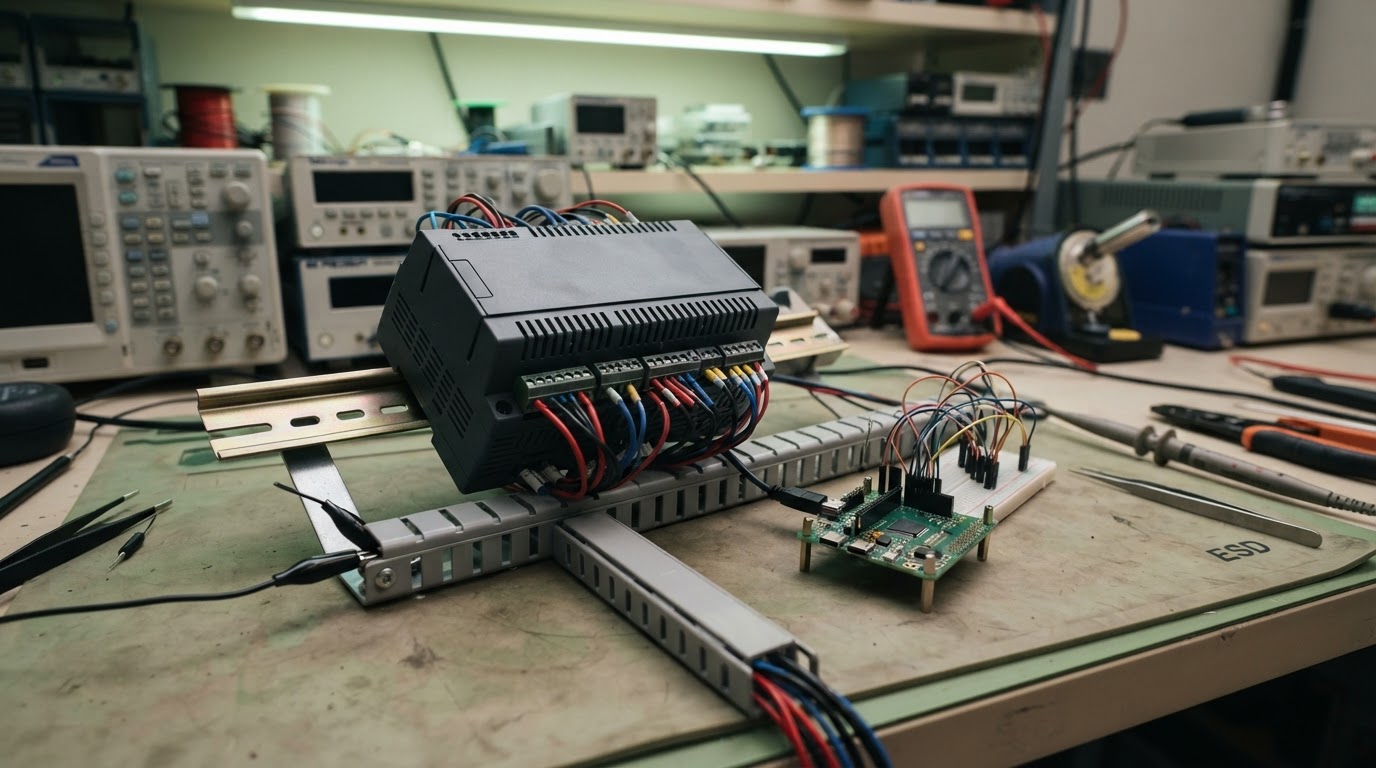
That distinction matters for buyers looking for an affordable industrial PLC or an Arduino-compatible controller. A small ESP32 development board is excellent for prototypes, but a control cabinet expects different voltage levels, mounting methods, maintenance practices and protection against electrical noise.
The three layers behind an industrial ESP32 controller
Layer 1: the processor and firmware
An ESP32 provides computing, GPIO, communication peripherals and software development options. Depending on the exact chip and product, engineers can build applications with ESP-IDF, Arduino-based frameworks and other supported environments. This is a microcontroller platform, not a complete machinery-control specification. Software determinism, task scheduling, update procedures and fault handling must be designed and tested.
Layer 2: field-ready electronics
Industrial sensors frequently use 24 V digital inputs, 4–20 mA current loops, 0–10 V signals, RTDs, relays or other interfaces that should not be connected indiscriminately to the low-voltage pins on a bare ESP32 board. Industrial equipment adds appropriate signal conditioning and I/O modules, power conversion, protection, terminal blocks and communication transceivers. The applicable current, voltage, isolation and protection ratings depend on the exact controller and expansion module.
Layer 3: cabinet integration and operations
DIN-rail mounting, a suitable enclosure, grounding, protected power, documentation, spare parts and a maintenance plan turn hardware into a serviceable panel. Engineers must also define the system’s reaction to power loss, missing sensor data and communication failure. Those requirements apply whether the processor is an ESP32, an ARM MCU or a conventional PLC CPU.
ESP32 development board vs industrial ESP32 controller
| Decision point | ESP32 development board | Industrial ESP32 controller |
|---|---|---|
| Purpose | Learning, firmware development, prototyping | Integration into a designed automation panel |
| Field signal wiring | Often low-voltage GPIO needing additional circuits | Dedicated industrial I/O circuitry or expansion modules |
| Mounting | Bench or custom carrier PCB | Typically enclosure/DIN-rail form factor |
| Power | Often USB or regulated low voltage | Industrial supply input, per device specification |
| Communications | Board-dependent interfaces | Often Ethernet, RS-485, Wi-Fi or optional cellular |
| Responsibility | Designer builds the protective system | Still requires application-level electrical and safety engineering |
Neither column guarantees compliance with a particular standard. Review the published datasheet and any certification evidence for the exact product revision.
What does an ESP32 PLC actually do?
A connected controller might read machine run contacts, sample a level transmitter, show status on a display, log process values and transmit data to a SCADA system or cloud service. It may also operate contactors or other loads through correctly rated outputs and external protective circuitry. A typical program executes a cycle: acquire signals, validate them, update application state, generate outputs, and publish/log information. How quickly and reliably it can do so depends on hardware, firmware and the application’s validated timing budget.
Example: monitoring a water pump. A simple application might collect a pump-run dry contact, a motor fault contact and a 4–20 mA pressure transmitter, then create a local alarm and send data over Ethernet. Before ordering hardware, define whether the controller only monitors the pump or also commands it to start; the second design brings additional interlocks, output ratings and risk controls.
How the NORVI X platform fits
The NORVI X family uses an ESP32-S3-based CPU module with a touchscreen, Ethernet, Wi-Fi/Bluetooth and RS-485 communication. The NORVI X1 is oriented toward installations with local connectivity. The NORVI X3 adds a Quectel EC25 cellular modem; its use requires carrier and SIM compatibility checks.
Important: NORVI X CPU hardware does not replace a field-I/O module. Inputs and outputs come from compatible expansion modules. Modules can share I²C resources or use dedicated GPIO, so there are limits to which can be combined. If you need a BOM, start with our PLC I/O planning guide and the NORVI X module checklist.
When an ESP32 industrial controller is a good fit
- OEM monitoring: a repeatable custom product that needs a small footprint and a specific data interface.
- Retrofit telemetry: read existing sensors or PLC status without replacing an established control loop.
- Building or utility data collection: acquire energy or environmental information using suitable industrial interfaces.
- Purpose-built non-safety control: where the team can validate timing, interface behavior, power and recovery.
A conventional PLC may be a better fit when existing technicians require a standard ladder-logic workflow, a long-established vendor platform, integrated plant support or validated specialty modules. Read ESP32 PLC vs traditional PLC for a neutral decision matrix.
Common mistakes to avoid
- Connecting 24 V sensor wires directly to a low-voltage MCU pin without proper circuitry.
- Assuming “PLC” in a listing means ladder logic, safety certification or deterministic scan times.
- Buying a CPU before counting compatible input/output modules.
- Treating Wi-Fi or LTE as a guaranteed connection in a metal cabinet or remote location.
- Ignoring safe restart states, watchdog recovery and firmware update policy.
Frequently asked questions
Can you program an ESP32 PLC with Arduino?
Many ESP32-based industrial controllers support Arduino-related development workflows, but programming interfaces, libraries and hardware mappings are product-specific. Follow the exact manufacturer’s guide and test all I/O in a lab before field deployment. See the NORVI USA Arduino starting guide.
Is an ESP32 PLC cheaper than a regular PLC?
The processor or CPU may cost less, but total project cost includes I/O, panels, engineering, commissioning and maintenance. Compare full installed system costs rather than CPU-only prices.
Does an ESP32 PLC replace a safety PLC?
Do not assume it does. A safety function requires an independently evaluated architecture appropriate to the risk, including devices, logic and final switching elements.
Explore controllers
Use our ESP32 industrial PLC buyer’s guide to evaluate the right platform or ask NORVI USA to review your control requirements before purchasing modules.
Reference: NORVI X1 and X3 product datasheets and module documentation reviewed November 2026; exact product revisions and approvals should be reconfirmed at selection. Technical documentation.