
Bottom line: An ESP32 industrial controller is a credible choice for custom monitoring, connected automation and OEM designs when the engineering team can maintain the firmware and validate the system. A traditional PLC is often preferable when the plant values a standardized programming workflow, a broad certified I/O ecosystem, established maintenance support or documented cycle-time behavior. Neither category is automatically the right answer for every machine.
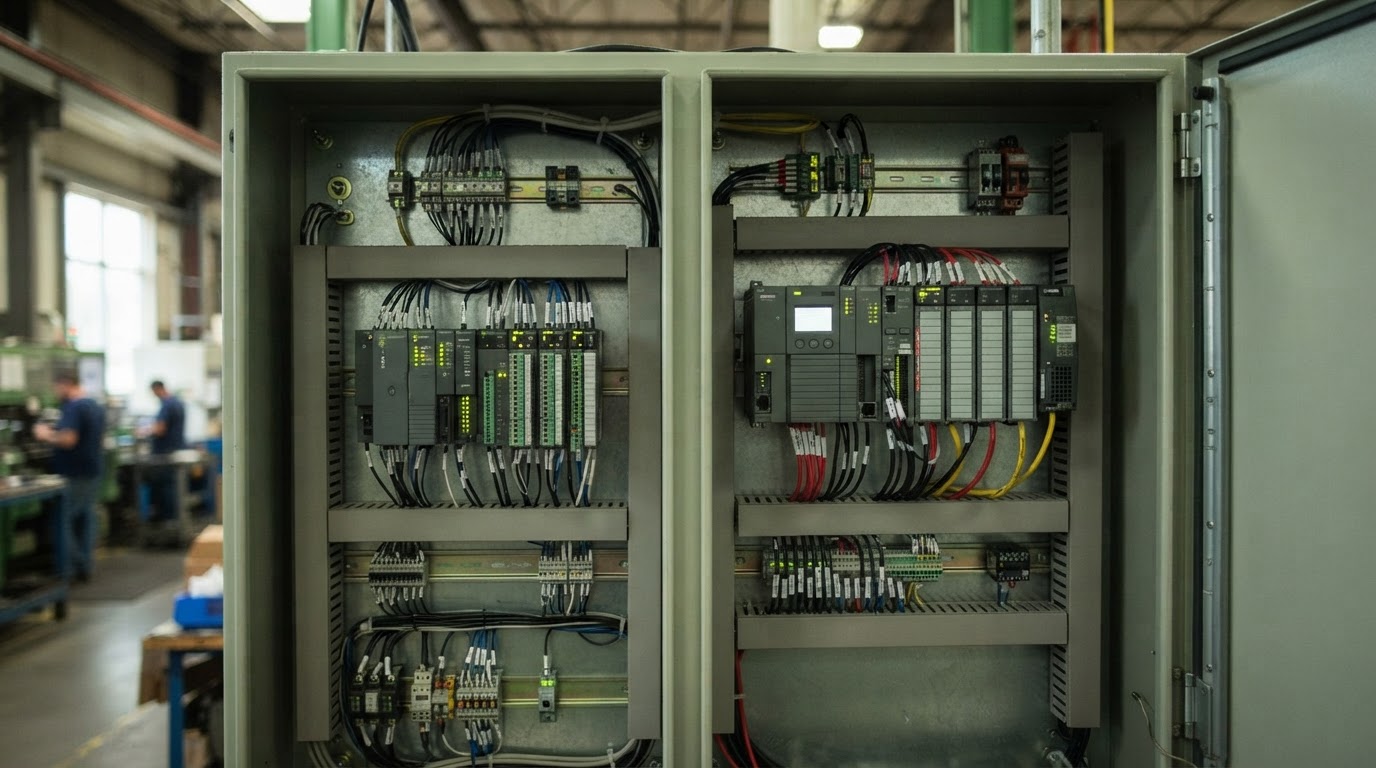
The ESP32 PLC vs traditional PLC question is frequently framed as a hardware-price contest. That misses the bigger issue: which platform delivers the required behavior throughout the equipment’s lifetime at an acceptable engineering and operational cost?
What is being compared?
A traditional programmable logic controller typically arrives as a complete vendor platform with a processor, defined industrial I/O, a designated engineering environment, documented industrial operation and an established service ecosystem. An “ESP32 PLC” normally describes a programmable industrial controller built around an ESP32 and equipped with field interfaces and enclosure hardware. Some products market themselves using PLC language but use Arduino/ESP-IDF workflows instead of IEC 61131-3 ladder logic. Check each exact model rather than assuming feature equivalence from the name.
Side-by-side engineering decision table
| Consideration | ESP32-based industrial controller | Traditional PLC platform |
|---|---|---|
| Firmware development | Flexible embedded software; developer expertise matters | Often standard PLC languages and integrated engineering tools |
| Connectivity | Frequently convenient for Wi-Fi, embedded networking, IoT and cloud APIs | Strong plant-network and industrial protocol ecosystems, model-dependent |
| I/O selection | Depends on industrial controller/compatible modules | May offer broader vendor-certified module families |
| Diagnostics | Must be designed or selected for the application | Often standardized diagnostic and service workflows |
| Timing assurance | Needs measurement and application-specific validation | Often documented scan/task behavior and industrial control features |
| Lifecycle | Depends on supplier plus in-house software support | Often supported through established automation channels |
| Safety applications | Do not assume safety-rated features | Safety-PLC models exist; standard PLCs are not automatically safety-rated either |
| Hardware entry price | Can be attractive for compact/custom projects | Varies widely by model, licensing and modules |
These are general tendencies, not test results or claims that every product in either class performs the same way.
Use an ESP32 industrial controller when…
You need to connect a machine to a dashboard
A machine with an existing reliable control system may need a companion device to read digital status, trend an analog signal, time-stamp events or publish telemetry. A programmable industrial IoT controller can often perform this role without replacing the production PLC. Design its interface to avoid compromising the original safety or control functions.
You build a repeatable OEM product
An OEM team that owns embedded firmware and ships many similar units may benefit from a compact programmable platform and modular I/O. The payback depends on whether firmware testing, field upgrades, documentation and a common spare-parts policy are included from the start.
You need a specialized integration
A custom cloud connection, user interface or nonstandard sensor workflow can be simpler to implement with a broadly supported embedded software stack. The engineering burden shifts to your team, so plan for observability and recovery rather than judging only development speed.
Use a traditional PLC when…
- A plant requires technicians to work in its approved PLC programming standard and service-tool ecosystem.
- A production process relies on documented control scan times, tightly integrated vendor modules or validated maintenance routines.
- The machine’s owner requires a long-term controller platform that multiple maintenance crews can support.
- The application calls for a properly selected safety-rated control platform or specialized certified controls.
Traditional PLCs are not the same as safety PLCs. The correct safety architecture follows an application risk assessment regardless of which processor handles ordinary automation tasks.
Case example: a remote water site
Suppose a site already has a pump controller but lacks internet access and remote telemetry. Replacing the whole control system could create unnecessary risk and commissioning effort. A companion device, such as a NORVI X3 industrial IoT controller with compatible inputs, may be worth evaluating to collect status and publish readings over LTE. This is a monitoring example—not evidence that a cellular module guarantees carrier service or that a generic MCU should take over protective pump logic.
For a networked plant cabinet with Ethernet, an X1 may be the more appropriate starting point. The existing X1 vs X3 guide breaks down that choice.
What about software licensing and total cost?
Calculate CPU + I/O + power + enclosure + installation + software engineering + validation + training + support. A lower-cost processor does not erase recurring field calls, firmware maintenance or the value of a plant’s existing expertise. Conversely, a custom OEM application may avoid complexity by using an open embedded workflow instead of imposing a large automation platform on a simple telemetry use case.
Our industrial PLC cost guide provides a worksheet and shows which expenses are commonly omitted.
Five questions that settle the decision
- Is this monitoring or controlling a potentially hazardous process?
- Which digital, analog and communication I/O is needed, including expansion and sensor conversion?
- Who will edit, validate and recover the software five years after installation?
- Does the application require documented scan behavior or a vendor-specific fieldbus/ecosystem?
- What is the lifecycle cost if a network, sensor or power supply fails?
Start with the ESP32 industrial PLC selection guide for a complete requirements brief.
Frequently asked questions
Are ESP32 PLCs real PLCs?
They are programmable controllers that may meet industrial equipment needs. “ESP32 PLC” alone does not establish ladder-logic support, application certifications or safety-rating equivalence.
Can ESP32 controllers run Modbus?
Many can support Modbus through suitable firmware and hardware interfaces. RS-485 is not itself Modbus, and a particular product must be configured and tested for protocol support.
Can an ESP32 PLC replace an Allen-Bradley or Siemens PLC?
Only after a requirements-based engineering review. Inventory required protocols, I/O, timing, lifecycle, programming workflow, safety functions and integration. Avoid a one-for-one replacement assumption based on CPU price.
Need an engineering fit check?
Send NORVI USA your existing controller, I/O schedule and intended network. We can identify appropriate NORVI X hardware for further technical review without assuming it should replace a proven installed PLC.
References: NORVI X manufacturer datasheets and configuration documentation, plus general distinctions between embedded-controller and traditional PLC workflows. Reviewed November 2026. NORVI USA documentation.