
Quick answer: Choose an ESP32 industrial PLC by defining the field I/O, network, power and failure behavior before comparing CPU specifications. A DIN-rail ESP32 controller can be a practical option for connected machine monitoring and custom automation, but an ordinary development board is not a direct substitute for a properly engineered industrial control system.
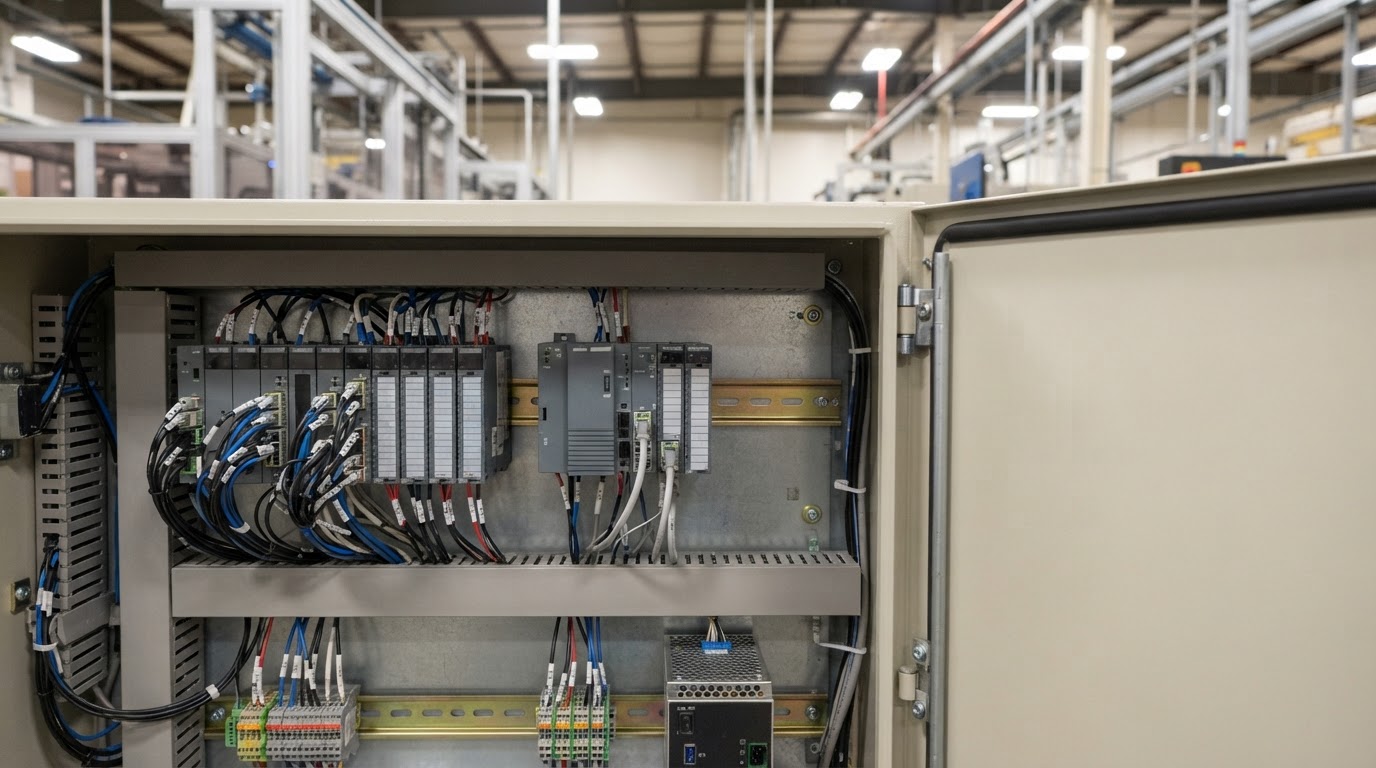
Engineers searching for an ESP32 industrial PLC often have one of two goals: replace a bulky controller with a flexible lower-cost platform, or add connected monitoring without redesigning an existing machine. Both are valid—but they require different hardware, software and validation decisions. This guide maps those decisions to a real purchase checklist, using the NORVI X modular controller family as one concrete example.
If you are new to the platform, first read what an ESP32 industrial PLC is and how it differs from a development board. It will help distinguish processor features from the field-ready hardware needed in a plant.
1. Start with a one-page control requirements brief
Before choosing a controller, record the process and its consequences if it stops. Define what the machine reads, what it must switch, whether the controller is supervisory or controlling a critical process, and which failures need independent protection. That last distinction matters: emergency stops, machinery safety functions and other risk-reduction measures need safety-rated designs appropriate to the application, not general-purpose firmware alone.
| Question | Record before ordering | Why it matters |
|---|---|---|
| What signals exist? | Digital inputs, analog ranges, pulse rates, RTD/thermocouple, outputs | Determines I/O modules and wiring |
| What must it control? | Valves, relays, contactors, alarms, monitoring-only | Determines outputs, isolation, protection and fail-safe behavior |
| Where will it live? | Indoor cabinet, dusty plant, outdoor enclosure, operating temperature | Determines protection, enclosure and thermal design |
| How will it communicate? | Ethernet, Wi-Fi, RS-485, cellular, SCADA/cloud | Determines CPU, protocol stack and ongoing cost |
| How is it serviced? | Local technician, remote updates, logging, spare parts | Determines lifecycle and recovery design |
2. Count industrial I/O before choosing the processor
Make a signal schedule with signal name, device type, supply voltage, electrical range, update rate and required behavior on fault. Count separately: 24 V digital inputs, relay outputs, transistor outputs, 0–10 V inputs, 4–20 mA inputs, temperature measurement and communication interfaces. A 4–20 mA level transmitter cannot be connected to a voltage-only analog input without an appropriate conversion or compatible module.
For a compact pump-monitoring panel, for example, the field list might include two run/fault contacts, a pressure transmitter, a tank-level transmitter and one alarm relay. That is not a purchasing BOM yet: the relay’s load rating, analog ranges, terminal wiring, and fault behavior still need verification. Our detailed PLC I/O list and expansion planning guide shows how to turn the schedule into modules.
Fixed I/O vs modular I/O
A fixed-I/O controller can simplify a repeatable design with stable requirements. A modular platform is useful when an OEM builds several versions of the same machine or needs a different mix of signals per installation. NORVI X has a CPU module and separate I/O modules; the CPU itself should not be treated as a field-I/O package. Expansion-module counts and combinations depend on shared buses, I²C address limits and GPIO conflicts, not merely the headline number of supported points.
3. Choose the connectivity that will actually exist on site
Ethernet typically suits cabinets where network wiring and IT approval are already planned. Wi-Fi reduces physical network cabling but introduces radio coverage, authentication and interference questions. RS-485 is a physical interface often used for serial protocols, including Modbus RTU; it does not by itself guarantee Modbus compatibility. Cellular can serve remote assets but needs an approved SIM/data plan, supported carrier bands, antenna placement and recurring connectivity costs.
The NORVI X1 vs X3 comparison explains this decision for the products sold by NORVI USA: X1 is generally the starting point for available Ethernet/Wi-Fi networks; X3 adds a Quectel EC25 LTE modem for sites needing cellular access. Check local carrier compatibility before committing to an X3 installation.
4. Verify the 24 V supply and the installation environment
Industrial controllers should be selected as part of a panel, not in isolation. Verify rated supply voltage, current margin for all connected expansion modules, fusing or circuit protection, wiring size, grounding and surge exposure. Installations with sensitive analog measurements also need attention to cable routing, shield termination and ground loops. Follow the selected devices’ manufacturer instructions and applicable electrical codes.
The manufacturer lists NORVI X1/X3 as 24 V DC, DIN-rail-mounted controllers with IP20 enclosures; IP20 is not a waterproof or dust-tight outdoor rating. Outdoor or washdown uses require a suitable protective enclosure and an environmental review. The manufacturer’s operating limits must be checked for the exact SKU and the surrounding panel components. See the small industrial PLC panel checklist for a systematic walk-through.
5. Confirm what ‘PLC’ means in your project
ESP32 PLC is a common market term for DIN-rail industrial controllers built around an ESP32 processor. It does not automatically mean the controller supports IEC 61131-3 ladder logic, has the same lifecycle support as a traditional PLC, meets a specific functional-safety integrity level, or is suitable for deterministic high-speed control. Verify the actual programming environment, timing requirements, communication software and maintenance plan.
Where an Arduino/ESP-IDF-based controller can shine is a custom application with sensor aggregation, HMI displays, network connectivity, data logging or an OEM-specific feature. Where a traditional PLC often wins is an installation whose standard programming workflow, long-term plant support, established I/O catalog and validated maintenance processes are mandatory. Read our ESP32 PLC vs traditional PLC comparison before replacing an existing production controller.
6. Design for outages and service—not only day-one operation
Document the desired restart state after power loss. Decide what happens if a sensor reads outside its valid range, a network connection drops, the watchdog resets the CPU or storage becomes unavailable. Use appropriately engineered hardware interlocks and safe output defaults where risk assessment requires them. Include a test for clean power-up, power cycling, corrupted/absent sensor readings and loss of upstream communication.
Plan software maintenance, version control, firmware rollback and who owns the source code. An inexpensive controller is not inexpensive if a plant has to dispatch an engineer every time a router changes. Our controller reliability checklist covers commissioning and recovery tests.
7. Compare installed cost, not just the CPU price
The complete system may include a CPU, I/O modules, 24 V supply, cabinet, DIN rail, terminals, breakers, cabling, antenna, software engineering, testing, documentation and future support. Compare those line items between candidates. If cellular is involved, include connectivity and field-service costs. If you are retrofitting an existing plant, the cost of training and integration with present SCADA standards may outweigh a low CPU price. Review our industrial PLC total-cost breakdown.
8. NORVI X selection: a practical starting point
| Site condition | Starting point | Additional checks |
|---|---|---|
| Ethernet-equipped machine or panel | NORVI X1 | Required I/O modules, protocol software, power budget |
| Remote station requiring cellular | NORVI X3 | Carrier bands, SIM, antennas, remote firmware policy |
| Repeatable OEM machine variations | NORVI X CPU + approved expansion modules | Module mixing, GPIO conflicts, cabinet size, spares |
| Personnel-safety function | Application-specific safety-rated architecture | Formal risk assessment; do not rely on a general-purpose controller alone |
For specific X1 capabilities, see our NORVI X1 controller guide. For current product options, visit the NORVI USA catalog; not every manufacturer module is necessarily available through the U.S. storefront.
Frequently asked questions
Is an ESP32 an industrial PLC?
An ESP32 is a microcontroller. When integrated into suitable industrial hardware with protected I/O, industrial power, enclosure and appropriate firmware, it can serve as the processing core of a programmable industrial controller. Whether that equipment is a suitable PLC replacement depends on project requirements.
Can a NORVI X CPU connect directly to 24 V field sensors?
Use appropriately selected NORVI X expansion modules for field inputs and outputs. The CPU module is a computing and communications platform, not a full field-I/O panel by itself.
Does DIN-rail mounting make a controller industrial-grade?
No. It helps with panel installation, but electrical protection, temperature range, compliance, enclosure protection, software support and fault behavior also matter.
Can I use an ESP32 PLC for safety-critical machinery?
Do not assume a general-purpose ESP32 controller is a safety PLC. Safety functions require a risk-assessed, suitably rated control architecture and validation under applicable standards.
Manufacturer technical references
Check the primary NORVI documentation for exact hardware specifications and expansion limits: NORVI X1 datasheet, NORVI X3 datasheet and NORVI X expansion-module selection guidance. These are technical references; U.S. ordering and availability are handled here at NORVI USA.
Next step: send us your I/O schedule
Describe your supply voltage, field devices, cabinet conditions and network. Contact NORVI USA for controller and expansion-module selection help; include whether you want to monitor an existing PLC or control the process directly.
Technical reference note: Product examples were checked against NORVI X1/X3 manufacturer datasheets and NORVI X module-selection documentation available in November 2026. Engineering suitability, electrical ratings and local carrier compatibility must be confirmed for your exact configuration. See the documentation center.