
A small industrial PLC should be selected as a control-panel component, not as an isolated processor. Start with the required sensors and outputs, then evaluate the power supply, protective enclosure, communications, software and maintenance plan. Compact size and low CPU price help only if the installation can safely and reliably operate in the field.
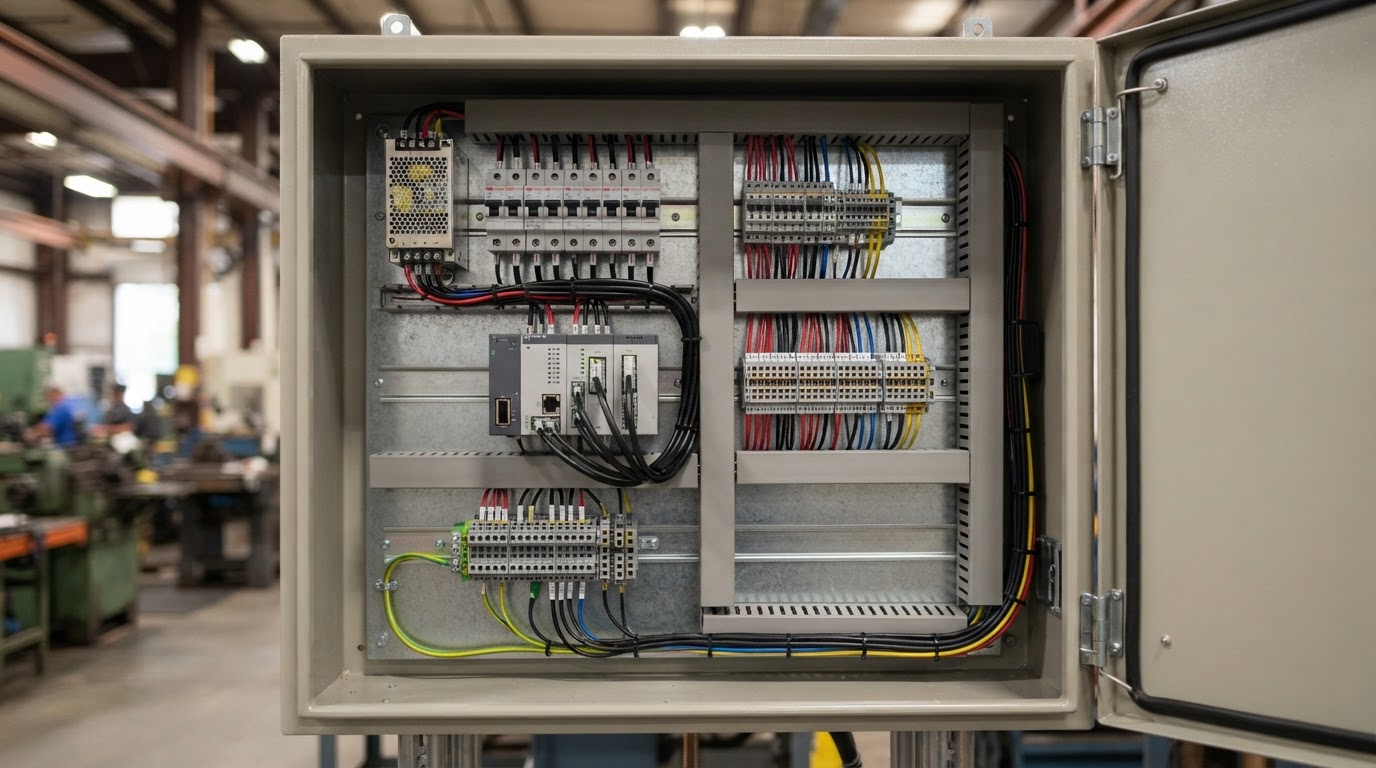
This checklist is for machine builders, maintenance teams, panel shops and OEM engineers evaluating a small industrial PLC, DIN-rail industrial controller or ESP32-based alternative.
1. Define the job and failure consequences
Write a short statement of the controller’s responsibility: monitoring, local automation, data logging, HMI support or external reporting. Identify which outputs can energize moving machinery or process equipment and define what must occur during fault and power-loss states. Safety-related functions require the appropriate protective architecture; a generic controller and its ordinary firmware are not automatically suitable for that role.
2. Build an I/O schedule
List each signal by terminal, field-device part number, electrical type, scaling and fault behavior. Distinguish a 24 V discrete input from a dry-contact input, 0–10 V from 4–20 mA, and relay from transistor outputs. Count future spare points separately from installed points. A modular controller may support additional points but each module has compatibility, bus and power limits. Use our PLC I/O planning template.
3. Check the rated 24 V DC supply
Many industrial control panels use 24 V DC, but never assume all components accept the same supply tolerance. Confirm the controller’s exact datasheet, inrush and steady-state current, connected I/O load, fuse/protection scheme and wiring size. Budget supply headroom instead of sizing it exactly at calculated nominal current. Include the expected brownout and restart behavior in commissioning tests.
4. Verify IP protection and the real installation environment
IP20, for example, protects against certain solid objects and accidental finger access but is not an outdoor water-ingress rating. NORVI’s X1 and X3 datasheets specify IP20 for the CPU enclosure, so a dusty, wet or outdoor location needs a suitable control cabinet or other protection. Verify expected ambient temperature at the hottest cabinet location, not just the building air temperature; power supplies and modules also generate heat.
5. Count DIN-rail width and wiring clearance
A cabinet footprint includes more than device width. Leave room for connector access, cable bend radius, service loops, adjacent power gear, wire ducts, terminals and expansion modules. Check the actual mounting orientation and ventilation recommendations. Reserve space for a future module only if it is compatible with the CPU and physical assembly.
6. Evaluate electrical noise and grounding
Contactors, variable-frequency drives and large motors create an environment unlike a lab desk. Plan cable separation, shield practice, surge protection, protective earthing and external suppression as appropriate. Choose I/O circuits for the real field voltage, sensor type and isolation needs; do not wire a 24 V field sensor into an exposed MCU GPIO pin.
7. Choose network paths and failure handling
For Ethernet or Wi-Fi, define IP addressing, IT ownership, firewall policy, secure remote access and what happens when connectivity disappears. For RS-485 networks, verify termination, wiring polarity, topology, protocol and baud-rate compatibility. For LTE, verify bands, carrier service, antennas and recurring costs. A modem on a datasheet is not a coverage guarantee.
8. Identify the programming and service owner
Ask which environment is supported, how firmware is updated, where source code is retained and how a technician diagnoses a fault. Can the equipment be recovered after a failed firmware upgrade? Can a replacement CPU be restored from a backed-up configuration? Software support is a line item in the purchasing decision.
9. Check compliance evidence—not marketing shorthand
Look for the exact SKU and revision’s declaration, test reports or manufacturer documentation for relevant EMC, electrical safety and programmable-controller standards. Markings and standard references on one model do not certify every configuration or make it a functional-safety PLC. A plant’s panel assembly and application may have additional regulatory requirements.
10. Evaluate replacement, documentation and total cost
Calculate controller + I/O + panel hardware + installation + commissioning + training + spare units + support. Establish whether the supplier can provide the selected modules, and document any modules that are not yet available in the U.S. catalog. For OEMs, decide what parts to standardize across equipment variants. See industrial PLC project cost for a detailed list.
Pre-purchase acceptance checklist
| Required evidence | Pass condition |
|---|---|
| Signal list | Every real device has a compatible input/output and allocated terminal |
| Power schedule | Controller and modules within rated supply and thermal limits |
| Panel layout | Space, environment, ingress protection, service access checked |
| Network test | Protocol, coverage and reconnection behavior verified |
| Recovery test | Safe power-up, loss-of-sensor, network-loss and restart scenarios tested |
| Documentation | Datasheets, wiring drawing, firmware version, service owner recorded |
Example: choosing a compact NORVI controller
For local Ethernet/Wi-Fi systems, compare the NORVI X1 CPU against the field I/O modules you need. For remote LTE use, evaluate the NORVI X3 plus carrier compatibility. The CPU requires compatible NORVI X expansion modules for process I/O; do not place the CPU on an I/O schedule as if it already had relay and analog terminals. Review our module selection checklist and X1 engineering overview.
Frequently asked questions
What makes a PLC small?
There is no universal size threshold. Buyers usually mean compact DIN-rail controllers with limited panel footprint and enough I/O for a specific local machine or monitoring application.
Can I install an IP20 controller outdoors?
Not exposed to outdoor weather. Evaluate a suitably rated enclosure, thermal management and field-wiring protection against the site’s actual environment.
Should I choose an ESP32 industrial controller or traditional PLC?
Decide from required programming workflow, technical support, timing, I/O, lifecycle and risks rather than size alone. See our side-by-side comparison.
Get a fit check before ordering
Share your field I/O count, 24 V supply details, panel environment and network via the NORVI USA contact form. Our ESP32 industrial PLC buyer’s guide provides the full decision flow.
Technical note: Selection guidance is general. Confirm exact product datasheets, module compatibility and applicable electrical requirements before installation. Reviewed November 2026; documentation center.